

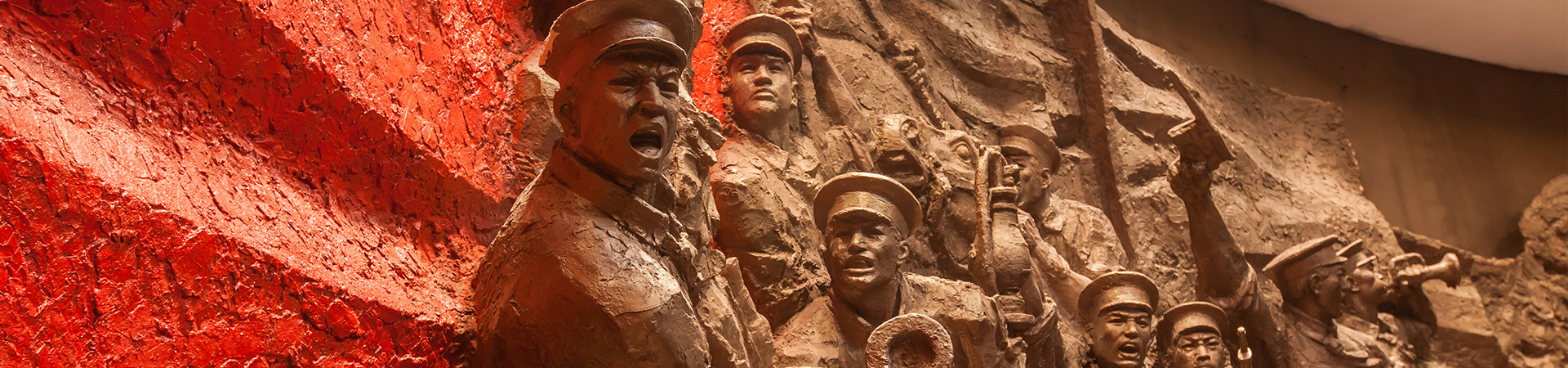
In recent years, there has been a review of research on the "August 1st Spirit" within the domestic academic community.
Release time:
2018-02-25
[Abstract] The "August 1 Spirit" nurtured by the Nanchang Uprising has gradually become a topic of interest in the academic community in recent years. The "August 1 Spirit" has yet to reach a "public consensus", which provides scholars with greater room for in-depth discussions on the "August 1 Spirit". Reviewing the achievements of predecessors is expected to help the research on this issue develop in a more systematic and in-depth direction.
[Keywords] Research Review "August 1 Spirit" Academic Community
The Nanchang Uprising is forever etched in history for its groundbreaking achievements in the Chinese revolution and the people's army. The "August 1 Spirit" it nurtured has gradually attracted the attention of the academic community in recent years. The "August 1 Spirit" has not yet reached a conclusion, which provides scholars with more space to explore and discuss the "August 1 Spirit" from different perspectives. This article provides a brief review on this.
1. On the Positioning of the "August 1 Spirit"
What is "positioning"? In short, it is to determine its historical status. This is a fundamental issue in studying the "August 1 Spirit". However, for some time, the academic community in Jiangxi Province has held two different views on the positioning of the "August 1 Spirit".
One view holds that the "August 1 Spirit" is encompassed by the Jinggangshan Spirit, advocating that only one spirit should be mentioned in Jiangxi, which is the Jinggangshan Spirit, leading to the long-term neglect of the research and promotion of the "August 1 Spirit". The other view believes that the "August 1 Spirit" is an important component of the series of "spirits" in the democratic revolutionary process led by the Communist Party of China, along with the Jinggangshan Spirit, the Soviet Area Spirit, the Nanniwan Spirit, the Yan'an Spirit, and the Xibaipo Spirit, where each part has both commonalities and individuality, and the "August 1 Spirit" is a revolutionary spirit formed by the Communist Party of China during a specific historical period.
Chief researcher Yu Boliu of the Jiangxi Academy of Social Sciences believes in his article "On the Connotation of the 'August 1 Spirit' and the Forging of Military Soul" that "the 'August 1 Spirit' is the precursor and forerunner of the Jinggangshan Spirit, and the Jinggangshan Spirit is the extension and development of the 'August 1 Spirit'. We cannot downplay or ignore the significance of the 'August 1 Spirit' just because the remnants of the Nanchang Uprising went to Jinggangshan and integrated into the Jinggangshan struggle." The struggle of the Nanchang Uprising predates the Jinggangshan struggle, and its conditions were also unique, with Zhou Enlai as its core leader. It is recorded in history for firing the first shot against the armed reactionaries of the Kuomintang and taking the first step towards the independent leadership of armed uprisings by the Communist Party of China. The "August 1 Spirit" is a fearless revolutionary pioneering spirit formed by outstanding representatives of the Communist Party of China, such as Zhou Enlai, at a critical moment when the Communist Party faced life and death after the failure of the first revolution, filled with concerns for the country's future and the fate of the nation, braving the storm with blood and life. The "August 1 Spirit" is an important source of the Chinese revolutionary spirit, and it is a theoretical concept with an independent form that cannot be replaced by other spirits. Li Xiaosan, executive vice president of the Jiangxi Jinggangshan Cadre College, believes that the Jinggangshan Spirit originates from the Anyuan Spirit, the Huangpu Spirit, the August 1 Spirit, and the Iron Army Spirit. Guo Jiezong, president of Jiangxi Science and Technology Normal University, also believes that "the 'August 1 Spirit' is the cornerstone and source of the Chinese revolutionary spirit."
From the perspective of the entire New Democratic Revolution, the Communist Party of China has created and nurtured the Soviet Area Spirit, the Long March Spirit, the Yan'an Spirit, the Anti-Japanese War Spirit, the Xibaipo Spirit, and others. They are all concentrated embodiments of the fine revolutionary traditions of the Communist Party of China and are powerful spiritual weapons for the Communist Party to lead revolutionary struggles from one victory to another, serving as an extremely precious spiritual pillar for the Communist Party to defeat the enemy. If we compare this entire set of spirits to a main chain, then the "August 1 Spirit" is an indispensable brilliant link within it.
2. Definition of the Scientific Connotation of the "August 1 Spirit" and Its Main Characteristics
The academic community has different views on how to refine and summarize the "August 1 Spirit". Here, we may as well highlight the key points and provide a brief review.
The Jiang Tingyu Research Institute of the Military Museum believes that "the refinement and summary of the 'August 1 Spirit' should grasp three principles: derive from history, highlight individuality, and have characteristics of the times." Liu Zhonggang, a curator at the Military Museum, believes that the "August 1 Spirit" should reflect the revolutionary essence and purpose shaped by the Nanchang Uprising. The summary must be concise and impactful, inspiring and moving, distinct from the lengthy format used to summarize the Long March Spirit during the 70th anniversary of the Red Army's Long March in 2006. Liu Tinghua, a researcher at the Military Academy, stated: "When expressing and refining the 'August 1 Spirit', attention should be paid to reflecting its uniqueness and being simple and clear." Professor Liu Jingfang from the Central Party School said when discussing how to reflect the characteristics of the "August 1 Spirit": "It should be derived from history itself, based on in-depth research on the Nanchang Uprising, and grasp its essence from the height of the times." Researcher Peng Hong from the Central Literature Research Office believes that "evaluating the Nanchang Uprising and summarizing the 'August 1 Spirit' should not be exaggerated or overly demanding of predecessors, but should be related to the influence and constraints of the historical environment."
In summary, scholars should consider the following points when refining and summarizing the "August 1 Spirit": derive from history, have distinct individuality, be rich in contemporary significance, and be expressed concisely. Strive to achieve a perfect combination of content and form that truthfully reflects the essence of history and the inevitability of history.
(1) Definition of the Scientific Connotation of the "August 1 Spirit"
The so-called "definition" simply means to recognize its essential connotation and spiritual significance.
Researcher Chen Li from the Military Academy believes that "the 'August 1 Spirit' should be studied within a specific historical context to draw appropriate conclusions; it is impossible to demand perfection from a young party. The refinement of the 'August 1 Spirit' should fully consider factors such as decisive decision-making and effective organization." Professor Wang Jianghuai from the National Defense University pointed out in his article "The 'August 1 Spirit' Shines Forever": "The essence of the 'August 1 Spirit' is best reflected in: the party commands the gun as the military soul; firm revolutionary ideals as strength; correct strategic decisions as the odds of victory; and unity between the military and the people as the source of strength." Jiang Tingyu believes in his article "The Spirit of the August 1 Nanchang Uprising Lives On" that the "August 1 Spirit" should encompass the spirit of "not fearing violence and daring to fight"; the spirit of "independence and innovation"; the united front thought of "unity and cooperation to confront the enemy"; and the revolutionary spirit of "firm ideals and beliefs, and indomitable perseverance." Xu Wei, the former curator of the Nanchang August 1 Uprising Memorial Hall, believes that the connotation of the "August 1 Spirit" includes: firm revolutionary faith; daring to be the first; not fearing difficulties or sacrifices, selfless and fearless; striving to learn, daring to innovate, and continuously progressing.
Liu Zhonggang's article "Banner, Military Soul, and Rise" states that the "August 1 Spirit" refers to "banner, military soul, and rise." The banner raised during the Nanchang Uprising symbolizes armed struggle; the military soul refers to the people's army created and commanded by the Communist Party, emphasizing that "creation" must be the priority, which involves integration and transformation based on existing foundations, infused with new connotations to form a cohesive whole. "Establishing or founding" refers to the birth of something entirely new, without emphasizing the existing foundation. Starting from the respect for history, using "creation" is more appropriate and fitting. "Party command" honorably becomes the inherent quality of the people's army, distinguishing it from all old-style armies; "rise" has two meanings: first, survival, and then creation, encompassing the realization of ideals and beliefs, breaking and reconstructing the cultural environment, and becoming a spirit of enduring fighting spirit and striving for progress. Similarly, Yu Boliu's article "On the Connotation of the 'August 1 Spirit' and the Forging of Military Soul" is incisive and logically strong, focusing on theoretical analysis, supplemented by historical narratives for in-depth discussion. He believes that from a macro perspective, the Nanchang Uprising has four dazzling "highlights": it fired the first shot, created a people's army, embarked on a correct path, and produced a group of outstanding generals. He points out that "daring to be the first, listening to the Party's command, being unyielding, and fighting for the people" are the connotations of the "August 1 Spirit," where daring to be the first is the core, and listening to the Party's command is the soul.
Although there are various interpretations of the connotation of the "August 1 Spirit" in the academic community, there is still a certain consensus. In fact, any "spirit" is born in a specific historical context, is an objective existence and a necessary requirement for social development and progress, and to some extent represents the development form of social concepts. Therefore, each "spirit" must have its distinct characteristics, that is, individuality. If a certain spirit is distilled without individuality, only commonality, or if the spirits are very similar, then it does not constitute a true spirit. In summary, adhering to the principle of "evidence-based statements," specific issues must be analyzed specifically, avoiding following others blindly, and not speaking in generalities. So, where does the individuality of the "August 1 Spirit" lie? Considering various factors, it should at least encompass several elements: the raising of the banner (the banner of the Communist Party's independent leadership of armed struggle); the forging of the military soul (listening to the Party's command); rising in adversity (survival and creation, including the realization of ideals and beliefs, breaking and reconstructing the cultural environment, etc.); and decision-making thinking of "assessing the situation and making timely decisions" (that is, being decisive and good at making decisions, including the courage of resolution, etc.).
(2) The Main Characteristics of the "August 1 Spirit"
The "August 1 Spirit," as a form of social consciousness of the proletariat, is a revolutionary spirit first created during the Second Domestic Revolutionary War, and it holds original significance as the revolutionary spirit of the Communist Party of China. Its nurturing and emergence are not only intricately linked to past thoughts but also distinctly stamped with the historical imprint of a specific era, vividly interpreting the contemporary style of the Chinese national spirit. It is both a profound accumulation of the excellent spiritual bloodline of the Chinese nation and a product of the combination of the revolutionary style of the Communist Party of China and the Marxist worldview. It is also a cultural spirit that needs continuous improvement and development in building socialism with Chinese characteristics, keeping pace with the times. With its long-standing revolutionary tradition, rich cultural connotation, noble and outstanding moral demeanor, and the spirit of self-improvement, it has become the spiritual bloodline that connects the past, present, and future of the Chinese revolution. It is an organic entity that embodies revolution, nationalism, contemporaneity, and creativity.
3. The "August 1 Spirit" and Other Related Issues
(1) The "August 1 Spirit" and the Armed Uprisings in Various Regions, and the Creation of Revolutionary Bases
It is precisely because of the "first shot" of the Nanchang Uprising that various armed uprisings led by the Communist Party of China have successively occurred across the country. The "first shot" has already accumulated in the inner world of revolutionaries as a spirit of enduring fighting spirit and striving for progress. The bloodline of the "August 1 Spirit" nurtured by the Nanchang Uprising further sustains the faith, will, exploration, and creativity of revolutionaries.
A large number of uprising soldiers continued to persist in revolutionary struggle, leading uprisings in various places and making important contributions to the creation of the Workers' and Peasants' Red Army and revolutionary bases. Uprisings such as the Guangzhou Uprising (Ye Ting, Nie Rongzhen, Yuan Guoping, etc.), the Sangzhi Uprising (He Long, Zhou Yiqun, He Jinzai), the Hailufeng Uprising (Peng Pai, Dong Lang, etc.), and the Southwestern Jiangxi Uprising (Li Wenlin, Jin Wanbang, etc.) occurred. He Long, Zhou Yiqun, and Duan Dechang established the Xiang-E-West Revolutionary Base; Peng Pai, Dong Lang, and Yan Changyi established the Hailufeng Revolutionary Base; Li Wenlin established the Donggu Revolutionary Base; Xu Jishen participated in the creation of the Eyu-Anhui Revolutionary Base; Xu Chengzhang participated in the creation of the Qiongya Revolutionary Base... Among them, Comrade Mao Zedong highly praised the "He Long-style" base and the "Li Wenlin-style" base.
(2) The "August 1 Spirit" and Campus Cultural Construction
Without a firm belief in communism, it would be impossible to have heroic feats like the Nanchang Uprising, nor could there be the victorious march of the uprising army to Jinggangshan after setbacks, leading to the "spark of fire eventually becoming a prairie fire" in the Chinese revolution. The qualities of the predecessors of the Nanchang Uprising, such as rising in adversity and enduring hardships, shine with rational brilliance; it is not a dry and rigid preaching, but a concrete and vivid expression. Firm ideals and beliefs are the main tone of ideological and political education in the new era. Some scholars have analyzed the tremendous power generated by the original motivation of the "August 1 Spirit" from the great act of the Nanchang Uprising to the contemporary influential "China Red Song Conference," discussing the close relationship between the "August 1 Spirit" and campus cultural construction from three aspects: faculty construction, student team construction, and campus environment construction, fully playing the leading role of the "August 1 Spirit" in campus cultural construction. The discussion particularly emphasizes the ideological and political construction of students, as the "August 1 Spirit" is a continuation of the excellent spiritual bloodline of the Chinese nation, and as a concentrated display of the proletarian worldview, outlook on life, and values, it has a clear guiding role in the ideological and political education of contemporary students, serving as excellent material for cultivating national spirit. In response to the adverse trend of utilitarianism in contemporary value orientation and the self-centeredness of value subjects, it is essential to strengthen education on worldview, outlook on life, and values, focusing on closely integrating teaching with nurturing, drawing wisdom and nourishment from the historical experience of the Nanchang Uprising, and internalizing the "August 1 Spirit" into students' life beliefs.
(3) The "August 1 Spirit" and Independent Innovation
Innovation is a form of practice, an elevation of practice. Scholars have pointed out that the Nanchang Uprising created a new form in the history of the Chinese revolution, established a people's army, and conducted beneficial explorations on a series of major issues such as revolutionary leadership, land reform, party building, and the united front, accumulating valuable experience. The core of the "August 1st Spirit" is actually the innovative practice of "daring to be the first." The exploration of the path of the Chinese revolution by the Nanchang Uprising is consistent with the path of independent innovation. Building an innovative country, winning the initiative and active power in development, fundamentally relies on the power of science and technology, and the key is to significantly improve independent innovation capabilities. Today, when we study and promote the "August 1st Spirit," we aim to cultivate the original consciousness of the nation based on the change in historical positioning, making the establishment of an innovative country a consensus among the people.
(4) The "August 1st Spirit" and the development and utilization of red tourism resources in Nanchang and even Jiangxi.
As the cradle of the people's army, leaders of the Republic have always paid attention to Nanchang. Comrade Jiang Zemin even personally inscribed: "The place where the military flag rises."
Whether a city has charm depends to some extent on whether it has cultural characteristics. The "August 1st Spirit" rooted in the Nanchang Uprising is a unique cultural resource, an internal spiritual driving force, an advantage for economic development, and the core driving force for the rise of the heroic city of Nanchang. Vigorously promoting the "August 1st Spirit" is a powerful means to shape a new image of Nanchang and enhance the city's visibility, which is of great significance for improving Nanchang's cultural soft power and leading it to a new path of characteristic development.
Some scholars have proposed that to promote the "August 1st Spirit," we should vigorously organize, develop, and utilize red education resources related to the August 1st Uprising, such as relics, cultural artifacts, and historical sites, and deeply explore its rich cultural connotation. Increase infrastructure construction and tourism product development, maximize brand potential, and leverage brand effects. Carefully create the "August 1st brand," forming its unique cultural charm, and improve the quality and level of red tourism. Combine the "August 1st Spirit" with economic development, transforming the "August 1st Spirit" and resources into economic and commercial value, thereby attracting tourists, boosting popularity, uniting people's hearts, and promoting the construction of revolutionary old areas. For example, Linchuan in Jiangxi is the hometown of Tang Xianzu and Wang Anshi, and it is also the first transportation hub on the route of the Nanchang Uprising army southward. While vigorously promoting its reputation as the "hometown of talented people," we should also pay attention to collecting valuable intangible cultural heritage related to the Nanchang Uprising and emphasize the excavation and promotion of red historical resources.
In addition, the academic community has also conducted research on the issues of the "August 1st Spirit" and the construction of the Poyang Lake Ecological Economic Zone from the perspective of regional economic development.
4. The contemporary significance and practical value of the "August 1st Spirit".
(1) Promoting the "August 1st Spirit" helps to inherit the national spirit centered on patriotism.
The national spirit is the spiritual support on which a nation relies for survival and development. In the long river of history spanning over five thousand years, the Chinese nation has formed a great national spirit centered on patriotism, characterized by unity, hard work, bravery, self-improvement, and creativity. The Communist Party of China is the inheritor and promoter of the Chinese national spirit. Some scholars believe that "the fundamental purpose of the Nanchang Uprising is to save the country and the people, and the history of the Nanchang Uprising struggle is the best interpretation of the Chinese national spirit." The "lofty revolutionary righteousness, firm ideals and beliefs, timely decision-making, and broad-mindedness" embodied by the Communists represented by Zhou Enlai endow the Chinese national spirit with new characteristics of the times and showcase the excellent qualities of the Chinese nation. The "August 1st Spirit" is the contemporary embodiment and new development of the Chinese national spirit, and the spiritual outlook it contains is the sublimation of our great national spirit. Promoting the "August 1st Spirit" is to promote the excellent culture of the Chinese nation, which is to promote the Chinese national spirit.
(2) Promoting the "August 1st Spirit" helps to establish a common ideal of socialism with Chinese characteristics.
After Chiang Kai-shek and Wang Jingwei successively betrayed the revolution, where would the Chinese revolution go? This was the primary question facing the still young Communist Party of China. The epoch-making Nanchang Uprising broke out under such severe circumstances. The reason why the Communists stood tall and unafraid in the face of the enemy's tyranny was that they always remembered: "The enemy can only take our heads, but can never shake our faith!" This resolute belief. He Long, Xu Teli, and others chose to stand with the Communist Party when many people withdrew from its ranks. Zhu De, known as "Old General Huang Zhong" by the soldiers of the Nanchang Uprising, endured hardships to lead the troops to Jinggangshan. History will never forget Chen Yi's profound mobilization at Tianxinwei... It was precisely because of their unwavering faith in communism that the soldiers and civilians of the Nanchang Uprising sacrificed themselves for the revolution.
Ideals and beliefs are the spiritual pillars of a person, a political party, and a nation. In today's world, national, and party situations are undergoing profound changes. To achieve the great rejuvenation of the Chinese nation, it is necessary to fully promote the "August 1st Spirit," emphasize the education of people's ideals and beliefs, and pay attention to media propaganda orientation. Focus on guiding party members to enhance their consciousness and determination to follow the path of socialism with Chinese characteristics, and to strengthen their consciousness and determination to implement the party's basic theories, basic lines, and basic programs, especially to be firm believers in the great ideal of communism and the common ideal of socialism with Chinese characteristics.
(3) Promoting the "August 1st Spirit" helps to strengthen the construction of the ruling party.
The construction of the party is a long-term and arduous task. Mao Zedong once boldly referred to it as a "great project." "The greatest political advantage of our party is its close ties with the masses, and the greatest danger after the party comes to power is detachment from the masses," which has become our consensus. Today, the Communist Party of China is facing severe tests from all sides and unprecedented major challenges, facing the arduous task of strengthening its own construction. Some scholars believe that we should protect the party's survival with the sense of mission like that of the Nanchang Uprising, and strengthen the party's construction with a reform and innovation posture; we should adhere to the political principle of "the party commands the gun" like the Nanchang Uprising, creatively carry out anti-corruption and integrity construction; we should mobilize the masses, rely on the masses, and respect the pioneering spirit of the masses like the Nanchang Uprising, protecting and supporting the smooth progress of nationwide reform and innovation practices. The "August 1st Spirit" provides a historical mirror to highlight the lofty revolutionary purpose of serving the people, serves as a vivid textbook for tempering party character, and points out the path for continuously strengthening the construction of the ruling party in the new era. This is of great significance for improving the party's leadership level and governing ability, and for always maintaining and developing the party's advanced nature.
(4) Promoting the "August 1st Spirit" helps to cultivate the core values of contemporary socialism and the core values of revolutionary soldiers.
Some scholars believe that the "August 1st Spirit" has many commonalities with the socialist core value system in terms of guiding ideology, ideal belief orientation, theoretical form, and spiritual education value. The "August 1st Spirit" is an important path for building the socialist core value system in the new era. The former provides a carrier for conducting education on the sinicization of Marxism, education on ideals and beliefs, and education on socialist ideology, while the latter provides experiential materials and practical support for the theoretical innovation of the former.
The Central Committee of the Communist Party of China led by Zhou Enlai played a leading role in the Nanchang Uprising, exerting a core influence and firmly grasping the political direction of the troops. This laid a preliminary foundation for the military spirit of "the Party commands the gun" in the people's army. As the starting point of the people's army, the Nanchang Uprising's military practices laid an important foundation for transforming the old-style army and building a new type of people's army. The Nanchang Uprising army learned about warfare in the war, initially creating strategies and tactics suitable for the revolutionary war conditions of the time. Many scholars believe that "the Party commands the gun" is the essence and truth of the "August 1 spirit," an important source of our army's combat effectiveness, and a political advantage that must be cherished. The "August 1 spirit" is the most precious spiritual wealth of our Party and army, and it vividly reflects the core values of contemporary revolutionary soldiers: "loyalty to the Party, love for the people, serving the country, dedicating to the mission, and valuing honor." The core values of soldiers play a leading role in their ideological morality and behavior. Vigorously promoting the "August 1 spirit" is crucial for cultivating the core values of contemporary revolutionary soldiers, carrying forward our Party and army's fine traditions of obeying the Party's command, serving the people, and being brave in battle, providing strong spiritual strength for faithfully fulfilling our army's historical mission in the new century.
V. Research Characteristics and Prospects
Researchers fully utilize their creativity, starting from the historical materials of the Nanchang Uprising, conducting serious analysis and research, scientifically summarizing and evaluating the facts, arriving at rational understandings, and maintaining a high degree of unity between Party principles and scientific spirit.
However, compared to the Jinggangshan spirit, Long March spirit, Yan'an spirit, and Hongyan spirit, the academic community's research on the "August 1 spirit" is still not systematic or in-depth enough. Many viewpoints need further exploration, and many resources need to be tapped. From the perspectives of modern Chinese history, the history of the Communist Party of China, the history of Marxist parties, Party doctrines and Party building, philosophy, and political science, comprehensive and multi-angle discussions on the generation, formation, and development process of the "August 1 spirit" have yet to emerge, especially regarding the connotation of the "August 1 spirit," with few high-quality academic papers available. Most writings still focus on narrative historical facts; the sources of historical materials are biased towards the Communist Party of China, while those from the Kuomintang and the Communist International are quite weak, and a significant portion of the historical materials are memoirs. It is understandable to conduct discussions through the excavation of historical materials and the narration of events, but there are few articles that rise to a higher theoretical level to explore some deeper reasons. Additionally, the research perspective needs to be broadened, and research methods need to be absorbed and referenced; methods such as social anthropology, contradiction analysis, quantitative analysis, and psychological analysis can all be applied. Continuous innovation in research methods, means, and carriers is necessary.
In the absence of a definitive conclusion on the "August 1 spirit," many issues still need to be researched through debate. Nevertheless, conducting research on the connotation and essence of the "August 1 spirit" remains one of the central topics. Furthermore, how to explore more valuable research directions and broaden research fields; how to discuss the contemporary value of the "August 1 spirit," endowing it with modern elements, and aligning the research on the "August 1 spirit" with modernity—these all reflect and influence the development trends of the research. We have reason to believe that, based on the existing achievements of predecessors and in an atmosphere where the "August 1 spirit" continues to radiate contemporary value, the academic community's research on the "August 1 spirit" will surely become more comprehensive and thorough.
References:
[1] Wei Quanmu, Li Shulan. Learning and Promoting the Spirit of the August 1 Uprising [J]. Jiangxi Social Sciences, 1997, (7).
[2] Hu Yun, Ye An. On the "August 1 Spirit" and Shaping a New Image of Jiangxi People [J]. Jiangxi Social Sciences, 2002, (11).
[3] Li Chun. A Discussion on the "August 1 Spirit" and the Nanchang City Brand [J]. Journal of Jiangxi Science and Technology Normal University, 2007, (4).
[4] Ding Zhimeng. The August 1 Spirit and the Development of Nanchang [J]. Journal of the Party School of the Nanchang Municipal Committee of the Communist Party of China, 2007, (4).
[5] Yu Boliu. On the Connotation of the "August 1 Spirit" and the Forging of Military Soul [J]. Jiangxi Social Sciences, 2007, (8).
[6] Nanchang August 1 Uprising Memorial Museum. Proceedings of the Academic Seminar on the "August 1 Spirit" [C] (July 25, 2010).
[7] Guo Jiezong. The Cultural Connotation and Contemporary Value of the August 1 Spirit [J]. Journal of Jiangxi Science and Technology Normal University, 2010, (11).
[8] Jiang Tingyu. The Spirit of the August 1 Nanchang Uprising Lives On [J]. Journal of Jiangxi Science and Technology Normal University, 2010, (11).
[9] Liu Zhonggang. Banner, Military Soul, Rise Up—Starting from Reflections on the "August 1 Spirit" [J]. Journal of Jiangxi Science and Technology Normal University, 2010, (11).
[10] "The Sound of the August 1 Gun". Nanchang August 1 Uprising Memorial Museum Journal, 2010, (3-4).
[11] Li Rui, Wei Zuoguo. Vigorously Promoting the August 1 Spirit to Build a Socialist Harmonious Society [J]. Journal of the Party School of the Nanchang Municipal Committee of the Communist Party of China, 2007, (4).
[12] Xiao Yanyan. The Connotation and Contemporary Value of the August 1 Spirit [J]. People's Forum, 2010, (10).
[13] Hu Song, Luo Guohua. Promoting the August 1 Spirit: An Important Path for Building the Socialist Core Value System [J]. Journal of Jiangxi Science and Technology Normal University, 2010, (11).
[14] Wang Leifeng, Nie Huizhi. The August 1 Spirit is the Driving Force for Building the Socialist Core Value System [J]. Journal of Jiangxi Science and Technology Normal University, 2010, (11).
[15] Ye An. A Brief Discussion on the Formation of the August 1 Spirit and the Red Original Cultural System—Also Discussing the Promotion of the August 1 Spirit and the Shaping of the August 1 Brand [J]. Journal of Jiangxi Science and Technology Normal University, 2010, (11).
[16] Zhang Liang, Wu Meihua. A Brief Discussion on the Value and Practical Significance of the August 1 Spirit [J]. Journal of Jiangxi Science and Technology Normal University, 2010, (11).
[17] Li Zhe, Hu Song. Reflections on the August 1 Spirit [J]. Journal of Jiangxi Science and Technology Normal University, 2010, (11).
[18] Liang Xiaoyu. Theoretical Reflections on the Connotation of the August 1 Spirit and Its Contemporary Value [J]. Journal of Jiangxi Science and Technology Normal University, 2010, (11).
[19] Gong Kuilin, Huang Mei. On the Connotation and Contemporary Value of the August 1 Spirit [J]. Journal of Jiangxi Science and Technology Normal University, 2010, (11).
[20] Li Xing. A Brief Discussion on the August 1 Spirit [J]. Journal of Jiangxi Science and Technology Normal University, 2010, (11).
[21] Lin Teng. A Brief Discussion on the Connotation and Contemporary Value of the August 1st Spirit [J]. Journal of Jiangxi Science and Technology Normal University, 2010.(11).
[22] Shen Ping, Sun Jian. An Analysis of the Relationship between the August 1st Spirit and University Cultural Construction [J]. Journal of Jiangxi Science and Technology Normal University, 2010.(11).
[23] Su Xing. On the Enhancement of the Soft Power of Red Culture in Nanchang - Also Discussing the Contemporary Value of the August 1st Spirit [J]. Journal of Jiangxi Science and Technology Normal University, 2010.(11).
[24] Zhu Xiaoli, Yang Yuguang. Promoting the August 1st Spirit to Enhance the Cultural Power of Nanchang [J]. Journal of Jiangxi Science and Technology Normal University, 2010.(11).
[25] Yin Huiqiong. The August 1st Spirit and the Construction of the Hero City [J]. Journal of Jiangxi Science and Technology Normal University, 2010.(11).
[26] Hu Yun. On the Practical Value of the August 1st Spirit in the Construction of the Poyang Lake Ecological Economic Zone [J]. Journal of Jiangxi Science and Technology Normal University, 2010.(11).
[27] Tian Tian. Promoting the August 1st Spirit to Create "Clear Water of One Lake" in the Poyang Lake Ecological Economic Zone [J]. Journal of Jiangxi Science and Technology Normal University, 2010.(11).
[28] Wang Huguang. The August 1st Spirit and Campus Cultural Construction: The Cultural Connotation and Contemporary Value of the August 1st Spirit [J]. Journal of Jiangxi Science and Technology Normal University, 2010.(11).
[29] Tang Zhipeng. A Preliminary Exploration of the August 1st Spirit and Campus Cultural Construction [J]. Journal of Jiangxi Science and Technology Normal University, 2010.(11).
[30] Lin Qiuping. The Educational Value of the August 1st Spirit for Contemporary College Students [J]. Journal of Jiangxi Science and Technology Normal University, 2010.(11).
[31] Huang Shimin. Reflections on the August 1st Spirit and Enhancing the Cultural Soft Power of Nanchang [J]. Journal of Jiangxi Science and Technology Normal University, 2010.(11).
recommend News

Copyright 2021 Nanchang August 1st Uprising Memorial Hall All Rights Reserved |Bayi Pavilion WeiboWebsite construction:www.300.cn