

The first director talks about the Nanchang Uprising Memorial Museum.
Release time:
2018-02-25
On the eve of the August 1st Army Day, I interviewed the first curator of the Nanchang August 1st Uprising Memorial Museum, Mr. Feng Qinfu, in the heroic city of Nanchang. At the age of 85, Mr. Feng still has a clear mind and eloquently shared with us some anecdotes before and after the establishment of the memorial.
Selection of the memorial site and source of weapons
In April 1956, under the leadership of the Jiangxi Provincial Party Committee, the Nanchang Municipal Party Committee and Municipal Government decided to gradually open some revolutionary sites for the education of revolutionary masses. At that time, the Nanchang Revolutionary Site Restoration Office was established to investigate and organize all revolutionary sites in Nanchang and to carry out necessary relocation education for some residents. In November 1956, the preparatory office for the Nanchang August 1st Uprising Memorial Museum was established, with Mr. Feng Qinfu specifically responsible. In December of the same year, the command offices of the 20th Army and the 11th Army of the Nanchang Uprising were restored and displayed. In 1957, to commemorate the 30th anniversary of the founding of the army, the Jiangxi Provincial Military District, the Provincial Cultural Bureau, the Provincial Museum, the Ruijin Memorial Hall, and the preparatory office of the Nanchang August 1st Uprising Memorial Museum jointly organized the August 1st Uprising commemorative exhibition, with a funding allocation of 50,000 yuan from higher authorities, initially selecting the Jiangxi Grand Hotel as the exhibition site.
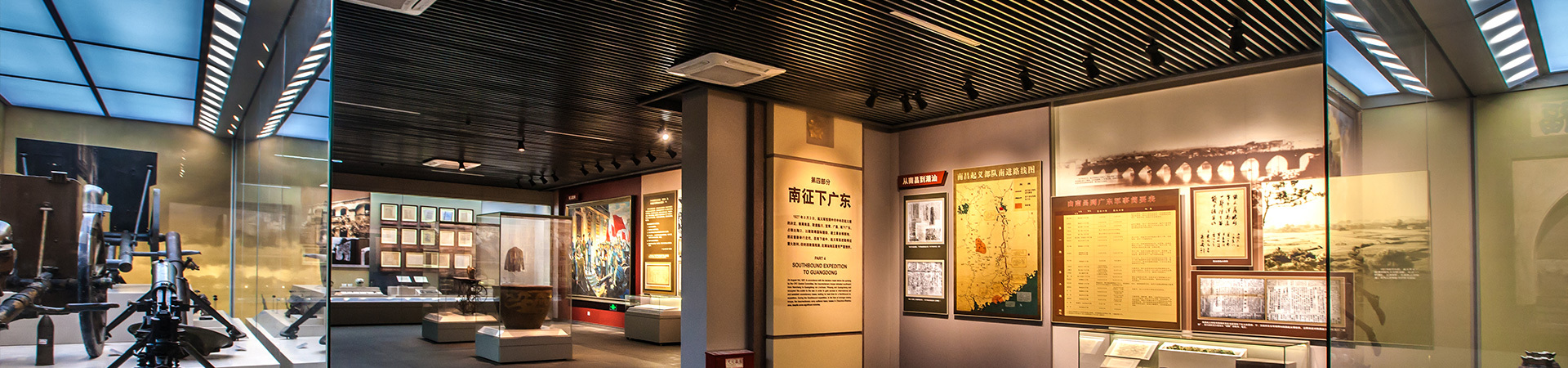
Mr. Feng told us that the main reasons for selecting the Jiangxi Grand Hotel as the exhibition site and the memorial site were: first, the Jiangxi Grand Hotel was the command center of the uprising at that time; second, it was the tallest building in Nanchang at the beginning of the founding of the country. The preparation work for the commemorative exhibition and the establishment of the museum was in full swing, and some old comrades who participated in the uprising sent various valuable cultural relics, but the most important was to collect the weapons used by the uprising army at that time. The preparatory office for the commemorative exhibition reported to the provincial military district, and General Deng Keming, the commander of the Jiangxi Provincial Military District, instructed: list the weapons needed for the exhibition and select them from the military warehouse. Most of the Nanchang Uprising troops were from the Northern Expedition Army, and the rifles used were the Qiangqiang rifles produced by the Guangdong Arsenal and Hanyang Arsenal. The list included: 12 Hanyang rifles, 6 Soviet-style water-cooled rifles, 6 Mauser rifles, 4 Soviet-style heavy machine guns, and 4 German 82mm mortars. These weapons were transported to the memorial for exhibition under the armed escort of a squad from the Jiangxi Xinyu and Longhua military warehouses. A batch of communication equipment and medical rescue equipment used during the Northern Expedition Army period was also continuously sent to the exhibition hall from various places, and the Jiangxi Provincial Military District also sent 4 cadres to assist in the exhibition.
Ranking of the leaders of the Nanchang August 1st Uprising
In June 1957, to commemorate the 30th anniversary of the founding of the army, the preparatory office of the Nanchang August 1st Uprising Memorial Museum wrote an article titled "August 1st Uprising" and wanted to publish it in the "People's Liberation Army Daily". At that time, it was still in the early days of the founding of the country, and there was no conclusion on the ranking of the leaders of the Nanchang August 1st Uprising. The ranking of leaders in the manuscript was Zhou Enlai, Zhu De, He Long, and Ye Ting. The People's Liberation Army Daily was very cautious about this, circling it in red and submitting it to Premier Zhou. After receiving the manuscript, Premier Zhou reviewed it overnight and instructed it to be circulated to General Zhu, General He, and General Chen. General Zhu said: "In the August 1st Uprising, my troops mainly did some coordination and support work, and their role was not significant, so they should be ranked after General Ye Ting." Premier Zhou instructed that Comrade Liu Bocheng served as the chief of staff of the uprising and worked diligently, making significant military contributions, and should be added to the list of uprising leaders, ranked after Zhu De. He also made important corrections and additions to the manuscript, such as adding "the uprising was based on Comrade He Long leading the 20th Army of the National Revolutionary Army, Comrade Ye Ting leading the 11th Army of the National Revolutionary Army, and Comrade Zhu De leading some comrades from the Public Security Bureau"; "the uprising's matters should seek He Long's opinion..."; changing "the reason for the failure of the uprising was that the enemy was numerous and we were few" to "the failure of the uprising was not entirely due to military defeat, but mainly due to political line errors, as the leaders at that time did not insist on mobilizing the masses and implementing land reform."
Chen Yi writes the name of the museum, He Long humorously talks about his one hundred-word application for party membership
On September 5, 1958, a black car slowly drove into the Nanchang August 1st Uprising Memorial Museum. At that time, most of the staff in the museum were out attending a report, and only the guides Gao Ruoxin and Peng Huizhen were on duty at home. The leader who got out of the car walked briskly, wearing a pair of tinted glasses, accompanied by someone who seemed to be a secretary. After visiting the hall on the first floor, he went up to the exhibition room on the second floor. He looked very focused, occasionally turning his head to whisper a few words to the secretary. In front of a group photo, he stopped and, with a strong Sichuan accent, called out the names of the people in the photo one by one. It wasn't until this leader wrote in the inscription book, "Chen Yi's third visit to Nanchang," that Gao Ruoxin was taken aback and exclaimed, "Chen Yi." Later, General Chen put away the inscription, saying he was not very satisfied and wanted to take it back to revise it. That afternoon, comrades from the provincial party committee office sent General Chen's new inscription.
On that day, Director Feng Qinfu and the staff also asked General Chen to write the name of the museum. After finishing the inscription, General Chen said, "My handwriting is not good; there are many calligraphers among the old comrades in the party. If you find someone better in the future, just replace mine!" From then on, the golden, powerful characters "Nanchang August 1st Uprising Memorial Museum" written by Comrade Chen Yi hung high above the entrance of the memorial.
On January 18, 1959, just after a cold wave, the sun was warm. Early that day, Director Feng received a notice that Comrade He Long was coming to visit the memorial. At 9 a.m., He Long, accompanied by Nanchang Municipal Party Secretary Guo Guangzhou, Mayor Zhang Yunqiao, and Chief of Staff Li Guoliang of the Provincial Military District, first visited the place where he worked during the uprising—the command office of the 20th Army. Entering the museum and returning to the birthplace of the revolutionary war, He Long was filled with emotions. He emotionally told Director Feng, "After liberation, some people said my motivation for joining the party was not right, that my feelings for the party were not deep, and that my application for party membership was only a hundred words. Haha, in fact, my application for party membership at that time was even less than a hundred words. During the Northern Expedition in Hunan, I knew that my political department director, Zhou Yiqun, was a Communist Party member, and I knew he was developing party members in my troops, but I pretended not to know anything. One time I told him I wanted to join the party, and he didn't approve, saying I needed to be tested further. One day I was looking for Zhou Yiqun and couldn't find him after searching several rooms. Later, I found Zhou Yiqun and a few others locked in a room taking an oath, with a hammer and sickle flag hanging on the wall. When they saw me come in, they all asked me to sit down, but I said I wouldn't sit; they should continue with their work. Later, I wrote a few dozen words in an application letter to Director Zhou, saying, 'Director Zhou, don't close that big door too tightly on me; let me in!'" Those present listened to General He Long's story of joining the party with great respect.
"People's Liberation Army Daily, August 7, 2000"
Previous Page
Previous Page:
recommend products


Copyright 2021 Nanchang August 1st Uprising Memorial Hall All Rights Reserved |Bayi Pavilion WeiboWebsite construction:www.300.cn