

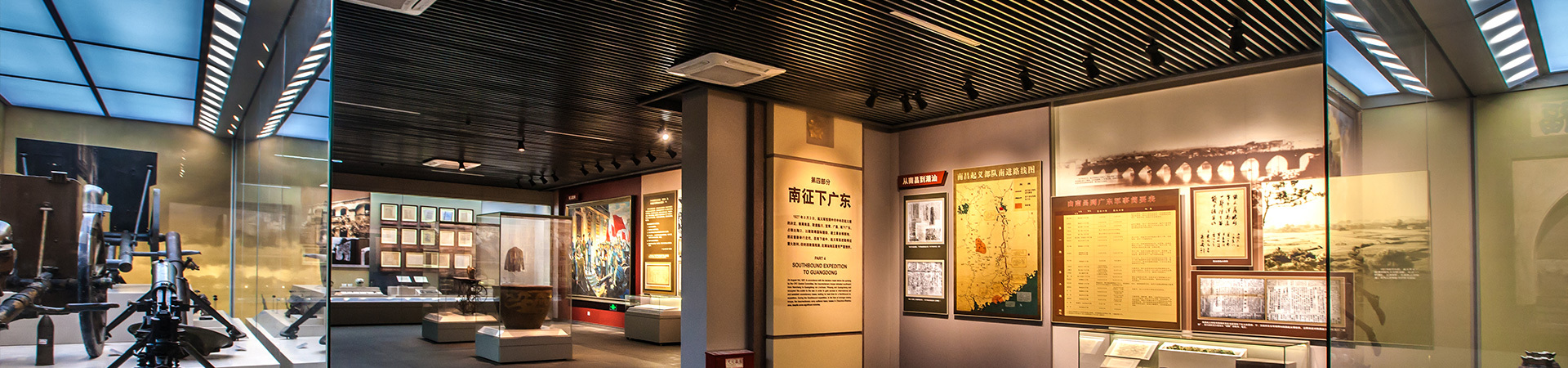
The Nanchang Uprising fired the first shot against the reactionary Kuomintang.
Release time:
2018-02-25
The Nanchang Uprising was an armed uprising led by the Communist Party of China on August 1, 1927, in Nanchang, Jiangxi Province, to save the revolution in the face of extreme crisis.
In April and July 1927, the Chiang Kai-shek and Wang Jingwei factions within the Kuomintang launched counter-revolutionary coups in Shanghai and Wuhan, brutally massacring Communists and revolutionary masses, leading to the failure of the anti-imperialist and anti-feudal Great Revolution.
In mid-July 1927, to resist the Kuomintang's massacre policy, the Central Committee of the Communist Party of China sent Li Lisan, Deng Zhongxia, Tan Pingshan, and Yun Daiying to Jiujiang, Jiangxi, to prepare to organize part of the Communist forces within the National Revolutionary Army, unite with Zhang Fakui, the commander of the Second Front Army, to return to Guangzhou, establish a revolutionary base, and then launch a new Northern Expedition. After Li Lisan and others arrived in Jiujiang, they found that Zhang Fakui had sided with Wang Jingwei and decided to independently launch military actions against the Nanjing and Wuhan Kuomintang governments. After learning of Li Lisan's proposal, the Central Committee officially decided to hold an armed uprising in Nanchang. They appointed Zhou Enlai, Li Lisan, Yun Daiying, and Peng Pai to form the front committee of the Communist Party of China, with Zhou Enlai as the secretary, to lead this uprising. The troops scheduled to participate in the uprising included: the 24th and 10th divisions of the 11th Army of the Second Front Army, the entire 20th Army, the 25th division of the 4th Army, the 73rd and 75th regiments, and the officer education regiment of the 3rd Army of the Fifth Front Army, totaling more than 20,000 people. In late July, the 11th Army and the 20th Army gradually concentrated in Nanchang under the command of Communists Ye Ting and He Long (who joined the Communist Party after the Nanchang Uprising).
On July 27, Zhou Enlai traveled from Wuhan to Nanchang via Jiujiang and established the front committee. The committee immediately decided to launch the uprising on July 30. On the morning of July 30, Zhang Guotao, who arrived in Nanchang as a representative of the Central Committee (then a member of the temporary Political Bureau of the Central Committee), insisted that the uprising should only be held after obtaining Zhang Fakui's consent. The committee members opposed Zhang Guotao's opinion, and Tan Pingshan was very angry, advocating to tie up Zhang Guotao, which was stopped by Zhou Enlai. Zhang Guotao's opinion was unanimously opposed by the committee. On July 31, the committee decided to act that night.
At 2 a.m. on August 1, under the leadership of the front committee of the Communist Party of China headed by Zhou Enlai, He Long, Ye Ting, Zhu De, Liu Bocheng, and others led more than 20,000 troops directly under the party's control to carry out the Nanchang Uprising. After more than four hours of fierce fighting, they annihilated more than 3,000 enemy troops and captured over 5,000 various guns, 700,000 bullets, and several cannons. In the afternoon, Nie Rongzhen led most of the 25th division of the Ma Huiling stationed near Nanchang to participate in the uprising and arrived in Nanchang on August 2.
To win over and unite some members of the Kuomintang who were willing to continue the revolution and expose the ugly face of Chiang Kai-shek and Wang Jingwei's betrayal of Sun Yat-sen's revolutionary spirit, this uprising still used the flag of the left wing of the Kuomintang. After the victory of the uprising, the Chinese Kuomintang Revolutionary Committee was established, electing Song Qingling, Deng Yanda (who did not arrive in Nanchang), He Long, Zhou Enlai, and 25 others as committee members, with Song Qingling, Deng Yanda, and 5 others forming the presidium. In the name of Song Qingling and others, they issued the "Central Committee Declaration," pointing out that Chiang Kai-shek and Wang Jingwei betrayed the revolution, calling on all revolutionaries to unite, inherit Sun Yat-sen's legacy, and continue to fight against imperialism and solve the land issue. The Revolutionary Committee appointed Wu Yuzhang as secretary-general and appointed Zhou Enlai, He Long, Ye Ting, and Liu Bocheng to form a staff team as the military command organ, with Liu Bocheng as the chief of staff and Guo Moruo as the director of the General Political Department, using the name of the Second Front Army of the National Revolutionary Army. The Revolutionary Committee appointed He Long as the deputy commander of the Second Front Army and Ye Ting as the acting commander of the front of the Second Front Army. The Second Front Army was composed of 3 armies: the 11th Army, with Ye Ting as the army commander and Nie Rongzhen as the party representative; the 20th Army, with He Long as the army commander and Liao Qianwu as the party representative; the 9th Army, with Zhu De as the deputy army commander and Zhu Kejing as the party representative; the total strength of the army was more than 20,000 people. On August 3, the uprising army began to withdraw from Nanchang according to the Central Committee's decision before the uprising, taking the route through Linchuan (Fuzhou), Yihuang, and Guangchang, heading south to Guangdong, aiming to restore the revolutionary base in Guangdong and seek external support, and then attack Guangzhou again. The uprising army did not realize that after exiting Nanchang, they should have gone to the vast rural areas of Jiangxi, Hunan, and Hubei to combine with the local peasant movement to expand revolutionary forces; instead, they hurried south to Guangdong to seek external support, putting themselves in a disadvantageous position.
The uprising army marched towards Guangdong, and when they reached Jinxian Village, the 10th Division defected to Chiang Kai-shek. Due to the hasty withdrawal from Nanchang, the troops were not reorganized, and coupled with the scorching heat, the troop strength was significantly reduced. By the time they reached Linchuan on the 7th, the total strength was about 13,000. During the southward journey, the uprising army engaged in several fierce battles with the Kuomintang troops. On August 25, the uprising army reached the area north of Renshan in Ruijin, taking advantage of the enemy's lack of concentration to launch an attack on the Renshan garrison, annihilating part of it, and on the 26th, they captured the city of Ruijin. They then attacked Huichang, fighting fiercely until the 30th, capturing the city of Huichang and annihilating more than 6,000 enemies, capturing more than 2,500 guns, with the uprising army suffering 1,700 casualties. After the battle of Huichang, the uprising army changed direction to the east, passing through Changting and Shanghang in Fujian Province, along the Ting River and Han River southward, occupying Sanheba in Dapu County, Guangdong, on September 22, and continuing southward to occupy Chaozhou (now Chao'an) and Shantou on the 23rd. The main force advanced westward towards Tangkeng (now Fengshun County), with a small number of troops remaining in Chaoshan. As the main force advanced towards Tangkeng, they engaged in fierce battles with the enemy again, suffering 2,000 casualties and unable to continue fighting, retreating towards Jieyang. The enemy occupied Chaozhou. The various units of the uprising army suffered serious defeats under the siege of the superior enemy in early October. The Revolutionary Committee and the leaders of the uprising army dispersed and relocated. A part of the uprising army, led by Dong Lang and others, moved to Haifeng and Lufeng areas to join local peasant armies. Another part, led by Zhu De and Chen Yi, moved to the border of Fujian, Guangdong, Jiangxi, and Hunan, participating in the Xiangnan Uprising, and in April 1928, they joined the Autumn Harvest Uprising forces led by Mao Zedong at the Jinggangshan revolutionary base.
Although the Nanchang Uprising failed, it fired the first shot in the armed resistance against the Kuomintang reactionaries, declaring the firm position of the Communist Party of China to carry the Chinese revolution through to the end, marking the beginning of the Communist Party of China's independent leadership of revolutionary warfare, the establishment of the people's army, and the armed seizure of power. Therefore, it has significant historical significance. On November 11, 1933, the temporary central government of the Chinese Soviet Republic decided to designate August 1 as the anniversary of the founding of the Chinese Workers' and Peasants' Red Army based on the suggestion of the Central Revolutionary Military Commission on June 30. From then on, August 1 became the founding day of the Chinese Workers' and Peasants' Red Army and the later Chinese People's Liberation Army. Zhu De commemorated "August 1" in a poem in July 1957, saying: "The Nanchang uprising gave birth to a new army, celebrating that the workers and peasants finally had soldiers."
Next Page
recommend products


Copyright 2021 Nanchang August 1st Uprising Memorial Hall All Rights Reserved |Bayi Pavilion WeiboWebsite construction:www.300.cn