

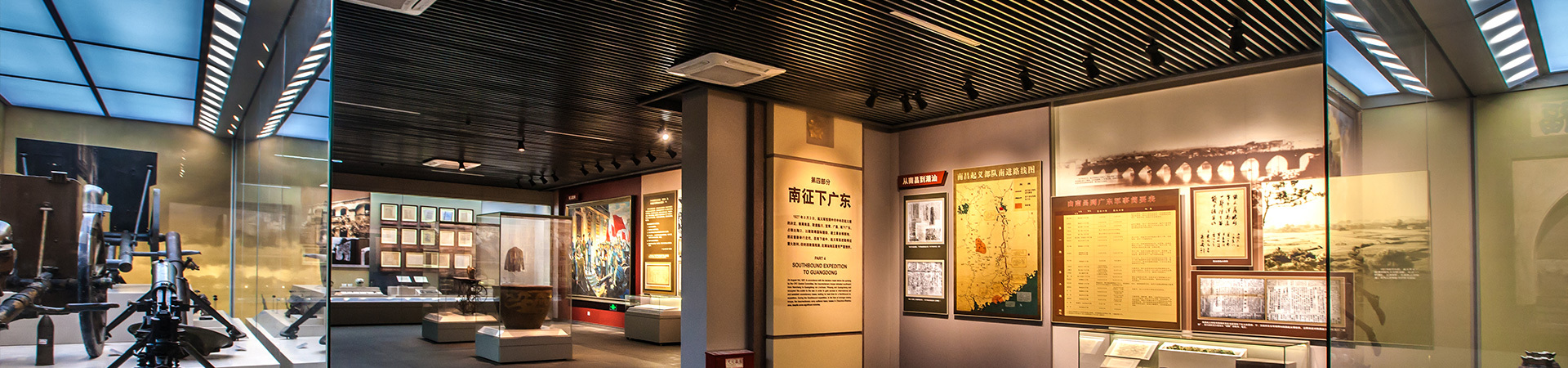
Great Decision
Release time:
2011-02-16
Name:Great Decision
Introduction:
The bloody lesson made the Chinese Communists realize the extreme importance of armed struggle. In order to save the revolution, in early July 1927, according to the instructions of the Communist International, the Central Committee of the Communist Party of China was reorganized, establishing a temporary Standing Committee of the Central Political Bureau, composed of Zhang Guotao, Li Weihan, Zhou Enlai, Li Lisan, and Zhang Tailei, which exercised the powers of the Central Political Bureau and stopped Chen Duxiu's leadership position. Subsequently, the Central Committee held a meeting in Wuhan to study the deployment of armed resistance against the reactionary Kuomintang, deciding to use the part of the Northern Expedition army controlled and influenced by the Communist Party as the main force, uniting with the commander of the Second Front Army of the National Revolutionary Army, Zhang Fakui, to return to Guangdong, restore the revolutionary base, implement land reform, and carry out the second Northern Expedition.
At that time, the armed forces that the Communist Party of China could influence and control included the 24th Division of the 11th Army led by Ye Ting, the 20th Army led by He Long, most of the 25th Division of the 11th Army, and the Third Officer Education Corps and the Wuhan Branch of the Central Military Academy led by Zhu De, as well as the Agricultural Training Class of the Wuchang Peasant Movement Institute, the Guangdong Peasant Army, etc. Among them, the troops led by He Long and Ye Ting and the 25th Division of the 11th Army were all under the command of Zhang Fakui, and these troops had already departed from Wuhan to Jiujiang under the banner of "Eastern Expedition to Suppress Chiang."
In mid-July, to implement the spirit of the Wuhan meeting, the Central Committee of the Communist Party of China sent Li Lisan, Deng Zhongxia, Tan Pingshan, and others to Jiujiang to understand the situation and guide the work. Zhou Enlai, the Secretary of the Central Military Commission, instructed Nie Rongzhen, He Chang, and Yan Changyi to form a front-line military commission to go to Jiujiang to carry out the preparatory work for the uprising.
On July 20, Li Lisan, Tan Pingshan, Deng Zhongxia, Ye Ting, Nie Rongzhen, and others held a discussion in Jiujiang and proposed for the first time the suggestion of "uprising in Nanchang." At that time, there were several considerations for choosing to start the uprising in Nanchang:
First, at that time, the Wang Jingwei group was accelerating the "cleansing of the Communists" in the army, and there was no progress in winning over Zhang Fakui. In this situation, if we did not act decisively and quickly start the uprising nearby, the armed forces controlled and influenced by the Communist Party would be at risk of being disintegrated and eliminated;
Second, there were only more than 6,000 enemy troops in Nanchang, while the uprising troops numbered about 20,000, giving them a numerical advantage and a greater chance of victory.
Third, transportation in Nanchang was inconvenient, with only one Nanchang-Xunyang railway, making it impossible for enemy reinforcements to arrive in time after the uprising.
Fourth, during the Great Revolution, the workers' and peasants' movement in Nanchang was high, providing a very solid revolutionary foundation.
On July 24, the temporary Central Committee of the Communist Party of China held a Standing Committee meeting in Wuhan and decided to "carry out an armed uprising in Nanchang" based on the suggestions from comrades in Jiujiang.
In late July 1927, Wang Jingwei and Zhang Fakui felt that He Long and Ye Ting's troops were "unstable" and attempted to summon He and Ye to Lushan under the pretext of a meeting to strip them of their military power. At that time, Ye Jianying, the chief of staff of the Fourth Army, who learned of the insider information, risked great danger to secretly leave Lushan for Jiujiang, where he found He Long, Ye Ting, Gao Yuhan, and Liao Qianwu. They discussed countermeasures on a small boat at Gantang Lake in Jiujiang: it was agreed that Ye and He would not go to Lushan for the meeting, would not execute the order to concentrate their troops in De'an, and would quickly lead their troops to Nanchang to prepare for the uprising. (Corresponding to the oil painting "Meeting on the Small Boat at Gantang Lake in Jiujiang.")
Comrade Ye Jianying made special contributions to the Chinese revolution on three occasions. This was one of them; the other two were: one was during the Long March, when he reported the situation of Zhang Guotao's conspiracy to split the party to the Central Committee and Chairman Mao in a timely manner, saving the party and the Chinese revolution at a critical moment. The second was in 1976 when the Jiang Qing counter-revolutionary group intensified its attempt to seize the highest leadership of the party; he stood up and, together with other comrades of the Central Committee, took decisive measures to crush the "Gang of Four" counter-revolutionary group, ending the disaster of the "Cultural Revolution" and once again making an indelible contribution to the cause of the Chinese revolution. Comrade Mao Zedong once praised Comrade Ye Jianying with the words, "Zhuge was cautious all his life, and Lu was not confused in major matters."
After the uprising troops arrived in Nanchang, they were warmly welcomed by the people of Nanchang. He Long set up the command post of the 20th Army in Hongdao Middle School. Ye Ting set up the command post of the 24th Division of the 11th Army in Xinyuan Middle School.
On July 27, 1927, Zhou Enlai traveled from Wuhan to Nanchang via Jiujiang. That evening, according to the decision of the Central Committee of the Communist Party of China, the front-line committee leading the Nanchang uprising was established at the Jiangxi Grand Hotel, composed of Zhou Enlai, Li Lisan, Yun Daiying, and Peng Pai, with Zhou Enlai serving as the secretary. Based on the preparations for the uprising, the front committee decided to start the uprising on July 30.
On the day of his arrival in Nanchang, Zhou Enlai stayed at the home of Zhu De at No. 2 Huayuan Corner, where he discussed the uprising plan with Zhu De. Zhu De had established the Third Officer Education Corps in Nanchang and had served as the director of the Nanchang Public Security Bureau from April to June 1927, making him very familiar with the situation in Nanchang, providing excellent advice and guidance for the uprising. The next day, Zhou Enlai moved to the Provincial Women's Vocational School near Xima Zhuang. There, he and other members of the front committee led the entire uprising under the code name "Artillery Battalion."
On the morning of July 28, Zhou Enlai arrived at He Long's command post to inform him of the uprising plan and seek his opinion. He Long firmly stated, "I will completely follow the Communist Party's instructions; I will do whatever the party asks me to do." Zhou Enlai immediately appointed He Long as the overall commander of the uprising army in the name of the front committee, responsible for the overall command of the military actions of the uprising under the leadership of the front committee.
Just at the critical moment when the preparations for the uprising were intensifying, the Central Committee received a telegram from the Communist International: "If there is a chance of success, we believe your plan is feasible," and sent Zhang Guotao, a member of the Standing Committee of the Central Political Bureau, to Nanchang as a representative of the Central Committee to convey the instructions of the Communist International and the Central Committee. On the morning of July 30, Zhang Guotao arrived in Nanchang. Due to his illusions about winning over Zhang Fakui, he insisted at the expanded meeting of the front committee that the uprising could only be carried out after obtaining Zhang Fakui's consent.
At that time, Zhou Enlai and most comrades believed that the situation was urgent, and our party should stand in the leading position of the uprising and could no longer rely on Zhang Fakui. After two days and nights of intense debate, the front committee made the final decision: the uprising could not be delayed and would take place at 4 a.m. on August 1, 1927. However, due to a betrayal by a deputy battalion commander of the 20th Army, the uprising was moved forward by two hours and was held at 2 a.m. Through the vivid imagery of the "Expanded Meeting of the Front Committee," we can understand the detailed situation at that time.
Previous Page
Previous Page:
recommend News

Copyright 2021 Nanchang August 1st Uprising Memorial Hall All Rights Reserved |Bayi Pavilion WeiboWebsite construction:www.300.cn