

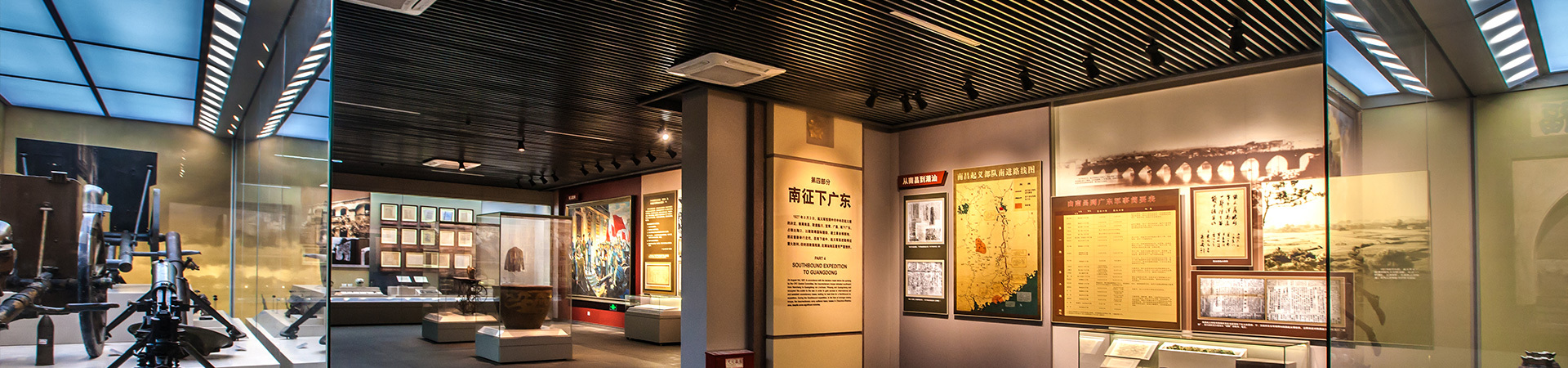
Panorama of the Nanchang August 1st Uprising Memorial Museum
Release time:
2011-02-16
Name:Panorama of the Nanchang August 1st Uprising Memorial Museum
Introduction:
Hello everyone, Nanchang is known as the Hero City and is the birthplace of the People's Liberation Army of China. Welcome to visit the Nanchang August 1st Uprising Memorial Museum. As we enter the museum, the first thing we see is a group of sculptures titled "Heroes of a Generation" created by the famous sculptor Chen Yunxian in 1997, commemorating the five leaders of the Nanchang Uprising: Zhou Enlai (center), He Long (second from right), Ye Ting (first from left), Zhu De (first from right), and Liu Bocheng (second from left). To the right of the sculpture is the famous gray building that exudes a sense of historical vicissitudes, which is the former site of the Nanchang Uprising Command. In front of the old site is another large bronze sculpture titled "Nanchang Uprising," which fully demonstrates the historical significance of the Nanchang Uprising through two groups of figures and the concrete elements of the uprising: the soldier holding a Mauser rifle signifies that the uprising fired the first shot in armed resistance against the reactionary Kuomintang; the hand holding a lantern symbolizes that the uprising ignited the spark of armed revolution; the raised bugle indicates that the uprising sounded the horn for the birth of the people's army and brave fighting.
Our museum was established in 1956 and officially opened to the public in 1959. The five revolutionary sites were listed as the first batch of national key protected units in 1961. The new exhibition building behind the bronze sculpture was expanded to commemorate the 80th anniversary of the founding of the army. The exterior of the building features a Great Wall pattern composed of rifle shapes and the August 1st font, along with decorative glass frames printed with five-star patterns, giving it a heavy, grand, solemn, and dignified appearance. Upon entering the building, we first arrive at the foyer, where there is a round sculpture titled "Shattering the Silence": the sculpture depicts a strong hand emerging from a broken stone, firmly gripping the trigger of a Hanyang-made rifle. One of the stones is inscribed with the moment the uprising began: 2 a.m. on August 1, 1927. This symbolizes the Chinese Communists' fearlessness in the face of danger, breaking through the white terror of the reactionary Kuomintang, and firing the first shot in armed resistance against the Kuomintang. Surrounding the round sculpture is the country's first large-scale combined sculpture, which presents six major themes: preparing for the uprising, public support, firing the first shot, celebrating the victory of the uprising, marching south to Guangdong, and meeting at Jinggangshan. Next, we will enter the exhibition hall.
The exhibition content is divided into two main parts: the Nanchang Uprising and the glorious history of the People's Army.
Previous Page
Previous Page:
recommend News

Copyright 2021 Nanchang August 1st Uprising Memorial Hall All Rights Reserved |Bayi Pavilion WeiboWebsite construction:www.300.cn