

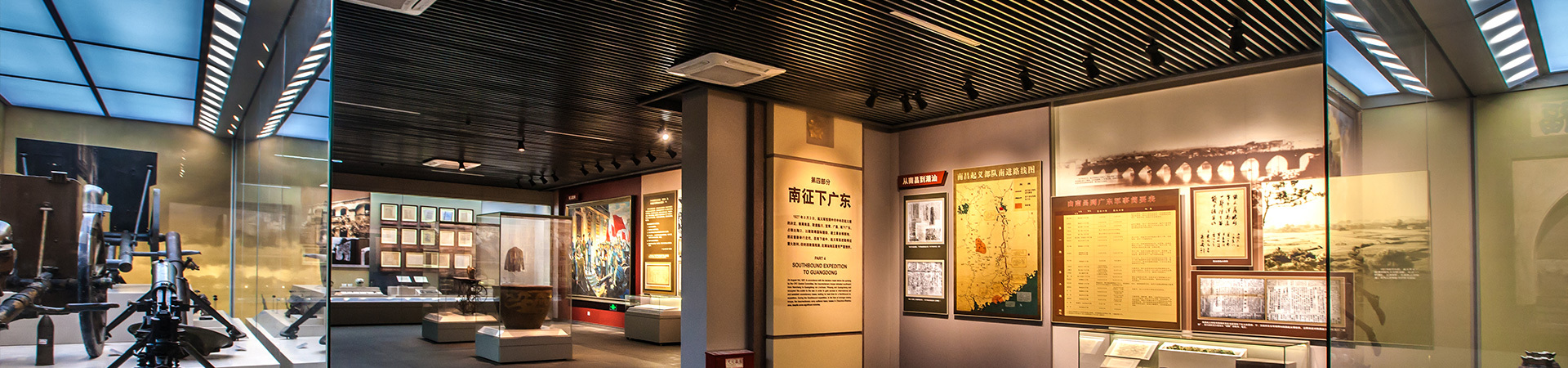
The military flag rises here - Seven of the ten marshals of China participated in the Nanchang Uprising.
Release time:
2018-02-09
Background information: The painful lessons from the failure of the Great Revolution made the Communist Party of China understand the importance of armed struggle and the truth that power comes from the barrel of a gun. In the early morning of August 1, 1927, Zhou Enlai, He Long, Ye Ting, Zhu De, Liu Bocheng, and others commanded an uprising army of more than 20,000 people. After several hours of fierce battle, they completely annihilated the enemy forces in Nanchang, firing the first shot of the Communist Party of China’s armed resistance against the reactionary Kuomintang. The Nanchang Uprising announced the beginning of the Communist Party of China’s independent leadership of the revolutionary armed struggle, and from then on, the People’s Liberation Army of China was born.
It was a rainy night when I arrived in Nanchang, with the mountains and water shrouded in mist, and the lights dim. However, it was precisely in such a night that the military flag sculpture on the August 1st Uprising Memorial Tower in the center of Nanchang stood out, reminding everyone that this is the "place where the military flag was raised" (this was inscribed by Jiang Zemin to commemorate the 70th anniversary of the Nanchang Uprising).
The uprising was imminent, and Zhou Enlai was appointed in a crisis.
74 years ago, China was in a state of white terror after the failure of the Great Revolution, with tens of thousands of Communist Party members brutally slaughtered by the reactionary Kuomintang. The Communist Party of China was at an extremely critical juncture of life and death. At the age of only 29, Zhou Enlai was appointed in this crisis to organize and launch the armed uprising in Nanchang according to the Central Committee's deployment. This year, at the age of 99, Xu Xianzhao, the only surviving participant of the Nanchang Uprising, recalled the situation at that time, saying: "At that time, the atmosphere in Nanchang felt so tense that even striking a match could explode in the air."
The uprising was not smooth sailing; due to traitors' informants, the originally scheduled time for the uprising was moved up from 4 a.m. to 2 a.m.
The August 1st Uprising succeeded, and the people's army was born.
At 2 a.m. on August 1, 1927, the gunfire of the uprising army shook the sleeping city of Nanchang. After just a few hours of fierce battle, the city of Nanchang had turned into a sea of red flags, and the August 1st Nanchang Uprising succeeded! The August 1st Nanchang Uprising declared to the world in the language of blood and fire that the Communists could not be frightened or exterminated. It was like a spring thunder on a clear day, allowing millions of revolutionary masses to see new hope in the darkness! From then on, the Communist Party of China had its own people's army, and the Chinese revolution opened a new chapter! Because of this, in July 1933, Mao Zedong, then chairman of the temporary central government of the Chinese Soviet Republic, signed a resolution stating that every year on "August 1" would be commemorated as the anniversary of the Chinese Workers' and Peasants' Red Army. Many years later, it was also specifically instructed that the military flag of the People's Liberation Army of China should have the words "August 1" on it.
Seven of China's ten marshals came from the Nanchang Uprising.
The director of the Nanchang August 1st Uprising Memorial Museum, Fa Jianming, told reporters that the great achievement of the August 1st Nanchang Uprising also lies in its cultivation of a large number of outstanding cadres for the party and the army. According to statistics, among the ten marshals, seven directly or indirectly participated in the Nanchang Uprising: Zhu De, He Long, Liu Bocheng, Nie Rongzhen, Chen Yi, Lin Biao, and Ye Jianying, and there were many generals and lieutenant generals who participated in the uprising. The Nanchang Uprising became the cradle of generals for the People’s Liberation Army of China.
The memorial museum attracts many visitors, and Nanchang's economy is taking off.
Today, the place where Zhou Enlai and others planned the uprising—the Jiangxi Grand Hotel—still stands in the bustling area of Nanchang after more than 70 years of wind and rain, although its name has changed to the Nanchang August 1st Uprising Memorial Museum since 1959. The museum is fully arranged in its original appearance, including Zhou Enlai's office and the general command meeting hall, unchanged for over 70 years. The exhibitions and cultural relic displays in the museum have become even more impressive this year due to the introduction of advanced sound and electrical technology and multimedia high-tech, allowing visitors to vaguely feel the tense atmosphere when the uprising was launched. A staff member pointed to the various buses that were already packed inside the museum and told reporters that this year, the number of visitors to the museum has reached the peak season ahead of schedule, almost 5 to 6 times that of previous years, and it is continuously on the rise every day.
In response to the increasing number of visitors to the memorial museum, the economy of Nanchang, this heroic city, is also accelerating. Recently, the great success of the Liaoning and Jiangxi Economic and Trade Fair has shown the vitality of this region. Walking on the streets of Nanchang, reporters can see extensive coverage of the economic and trade fair in local newspapers. In the words of a taxi driver: "Although Nanchang's economy is not yet developed, with the good policies of the party, our lives will definitely get better and better!" Special reporting team from this newspaper.
Next Page
Next page:
recommend products

Copyright 2021 Nanchang August 1st Uprising Memorial Hall All Rights Reserved |Bayi Pavilion WeiboWebsite construction:www.300.cn