

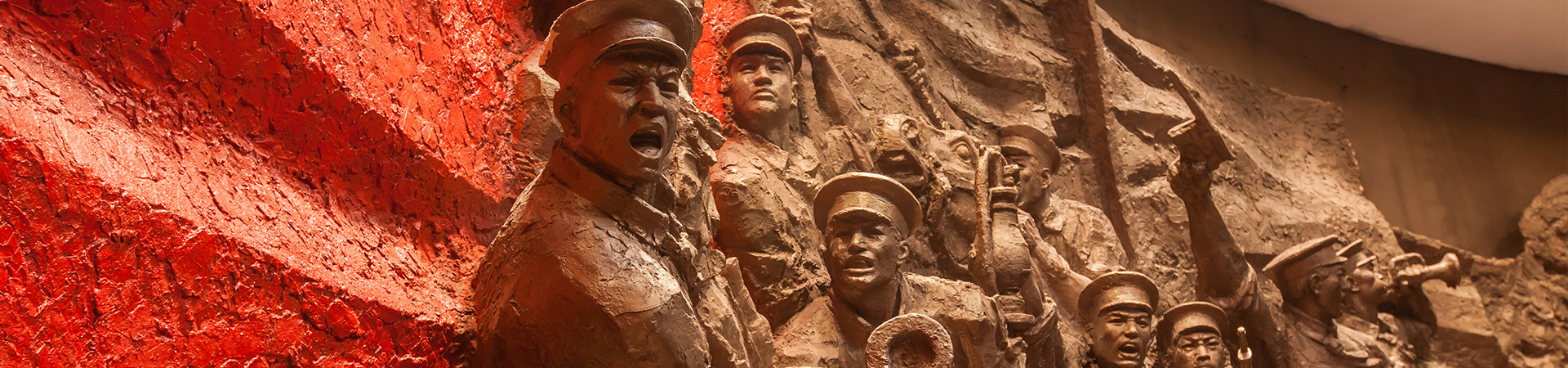

In the place where the military flag is raised, listening to the party's story ③: A party flag unexpectedly discovered among the ruins.
2018-08-16
The "Spirit of August 1st" and the "Urban Spirit" soar together.
"August 1st Spirit" and "Urban Spirit" Soar Together "Revolutionary Tradition" and "Urban Rise" Play in Concert — Discussing the Promotion of Nanchang's Urban Spirit by Leveraging the August 1st Spirit (Liu Xiaohua, Nanchang August 1st Uprising Memorial Museum) The urban spirit is the soul of a city. Since the proposal of Nanchang's urban spirit, due to insufficient promotion, it has not achieved a widely recognized and effective influence on guiding citizens' behavior and habits. The August 1st Spirit is a revolutionary traditional spirit rooted in Nanchang, with a higher level of public awareness and recognition than the Nanchang urban spirit. As two spirits that belong to the cultural category of Nanchang, they are not contradictory; rather, they support each other and shine together.
2018-08-16
A Discussion on the Total Volume of Public Debt Issuance in the Xiang-Gan Soviet Area
(Nanchang August 1st Uprising Memorial Hall Chen Hongmo Chen Haiyang) In the 1920s and 1930s, a vigorous Soviet movement emerged across China, with Jiangxi being the most fervent province for the Soviet movement. In addition to the central Soviet area centered in Ruijin, there were also the northeastern Jiangxi (later renamed Min-Zhe-Gan), Hunan-Hubei-Jiangxi, and Hunan-Jiangxi Soviet areas. Among them, the Hunan-Jiangxi Soviet area established in 1931 "spanned approximately a thousand miles, with a population of nearly 900,000." As a barrier for the central Soviet area, this red region straddling the border of Hunan and Jiangxi played a significant role in the Soviet movement and the land revolution war at that time. To support...
2018-08-16
Recently, the China Care for the Next Generation Working Committee issued a notice titled "Announcement of the First Batch of National Party History and National History Education Bases for Caring for the Next Generation" (Zhong Guan Gong Wei [2018] No. 9). The Nanchang August 1st Uprising Memorial Museum has been included in the list, becoming one of the first batch of "National Party History and National History Education Bases for Caring for the Next Generation" in the country.
2018-08-16
Information on the academic research achievements of the Nanchang August 1st Uprising Memorial Museum in 2015.
2018-08-16
Promote the August 1st Spirit and Enhance Red Tourism in Jiangxi
The Nanchang Uprising Memorial Hall, Chen Hongmo The Nanchang Uprising, which broke out in 1927, is a significant event in the history of the Chinese revolution. The uprising fired the first shot in the armed resistance against the reactionary Kuomintang, marking the beginning of the Chinese Communist Party's establishment of an army and the armed struggle to seize national power. From then on, the Chinese revolution entered a new historical period. Over 80 years have passed since the Nanchang Uprising; although the smoke of battle has dissipated from the city of Nanchang, the uprising has left a valuable spiritual legacy for the sons and daughters of this heroic city, one that is worth inheriting and promoting. So, what are the specific connotations of the August 1st spirit?
2018-08-16
Copyright 2021 Nanchang August 1st Uprising Memorial Hall All Rights Reserved |Bayi Pavilion WeiboWebsite construction:www.300.cn