


The People's Liberation Army of China has gone through a glorious journey of 90 years. As early as the founding of the Communist Party of China in 1921, the party began its initial military explorations. The program of the First National Congress of the Communist Party stated: "The task of the revolutionary army is to overthrow the old regime by revolutionary means together with the proletariat." Early leaders such as Zhou Enlai and Qu Qiubai successively proposed in the party's publications that "without a revolutionary army, warlords cannot be defeated" and that "there is an extreme need for a formal revolutionary army in the Chinese National Revolution." However, at this time, the Communist Party of China had not yet deeply understood the particularity of the Chinese revolution, and the issue of organizing an army had not yet been practically developed.
2017-07-30
The bloody lesson made the Chinese Communist Party realize the extreme importance of armed struggle. In order to save the revolution, in early July 1927, following the instructions of the Communist International, the Central Committee of the Communist Party of China was reorganized, establishing a temporary Standing Committee of the Central Political Bureau, composed of Zhang Guotao, Li Weihan, Zhou Enlai, Li Lisan, and Zhang Tailei, which exercised the powers of the Central Political Bureau and suspended Chen Duxiu's leadership position. Subsequently, the Central Committee of the Communist Party held a meeting in Wuhan to discuss the deployment of armed resistance against the reactionary Kuomintang, deciding to use the part of the Northern Expedition Army controlled and influenced by the Communist Party as the main force, and to unite with Zhang Fakui, the commander of the Second Front Army of the National Revolutionary Army, to return.
2011-02-16
Panorama of the Nanchang August 1st Uprising Memorial Museum
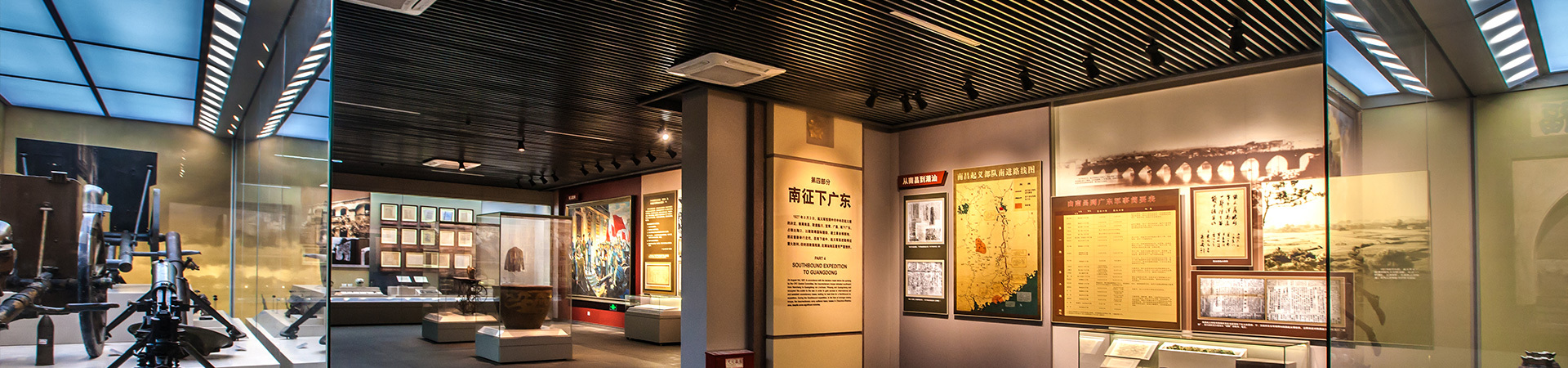
Hello everyone, Nanchang is known as the Hero City and is the birthplace of the People's Liberation Army of China. Welcome to the Nanchang August 1st Uprising Memorial Museum. As we enter the museum's main gate, the first thing we see is a group of sculptures titled "Heroes of a Generation," created by the famous sculptor Chen Yunxian in 1997, commemorating the five leaders of the Nanchang Uprising: Zhou Enlai (center), He Long (second from right), Ye Ting (first from left), Zhu De (first from right), and Liu Bocheng (second from left). To the right of the sculpture is the historic gray building that is the former site of the Nanchang Uprising Command Center. In front of the old site is another large bronze sculpture titled "Nanchang Uprising," featuring two groups of people.
2011-02-16
Awakening millions of workers and farmers | Busy dividing land and fields
On February 22, the Central Committee issued a document titled "Opinions of the Central Committee of the Communist Party of China and the State Council on Doing a Good Job in Key Work for Comprehensive Rural Revitalization in 2022." It proposed specific measures such as ensuring that the responsibility for farmland protection is shared by both the Party and the government, avoiding blind demolition of old villages to build new ones, and encouraging local governments to incentivize urban talent to serve rural revitalization. The "Central No. 1 Document" has become a term that signifies the importance the Central Committee and the State Council place on issues related to "San Nong" (agriculture, rural areas, and farmers). Since 2004, a Central No. 1 Document focusing on "San Nong" has been issued for 19 consecutive years, emphasizing the critical importance of these issues during the period of socialist modernization in China.
2011-01-16

Copyright 2021 Nanchang August 1st Uprising Memorial Hall All Rights Reserved |Bayi Pavilion WeiboWebsite construction:www.300.cn